← Back to Insights
Perspective
Dow 53,000 vs. Chip Stocks -5%: What the Headline Number Hides
July 6, 2026 · Avanor Consulting Services
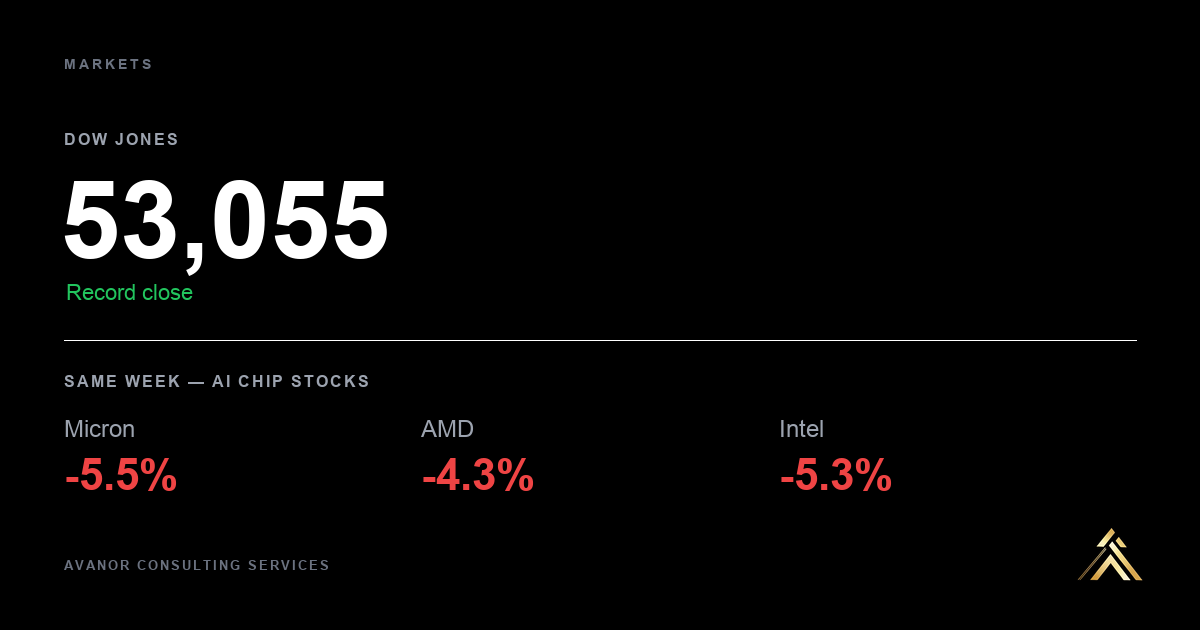
This week, the Dow Jones Industrial Average closed above 53,000 for the first time — a record close, capping a strong, holiday-shortened week for U.S. equities. The S&P 500 and Nasdaq both climbed alongside it.
The same week, three of the biggest names in AI infrastructure — Micron, AMD, and Intel — each dropped between 4% and 5.5% in a single trading session.
Same market. Same week. Two completely different stories.
If you only read the index-level headline, the week looked simple: markets at record highs, investors optimistic. But underneath that number, AI semiconductor stocks were in their second straight day of declines, with investors visibly nervous about how stretched their valuations had become after an extraordinary run-up.
A record close on the Dow and a 5% single-day drop in Micron are both true at the same time. Neither one is "the real story" on its own — the real story is in the gap between them.
What makes the chip selloff more interesting is that it wasn't driven by weakening demand. In the same window, Foxconn (Hon Hai) — a major NVIDIA supplier — reported stronger-than-expected quarterly sales, a direct signal that AI infrastructure demand was still running hot. Samsung was separately expected to report a roughly eighteen-fold year-over-year jump in operating profit.
So the underlying business wasn't the problem. The move looked far more like a valuation reset — investors questioning how much further overstretched AI chip prices could run, not whether the AI buildout itself was slowing down.
This is a market-level example of something that happens inside businesses constantly. A healthy consolidated number — total revenue, total profit, a rising index — can sit directly on top of real volatility in the parts that make it up.
The discipline that protects you isn't distrust of the headline number. It's the habit of asking what's underneath it before you make a decision based on it alone.
Talk to us about looking past the consolidated total to what's actually happening underneath.
Get in touch